Remember that our outer tent were left in the bus, when we were dumped by it in Ciudad del Este? Thanks to the help of Ela in Assucion calling the bus company when we were still in Ciudad del Este and the bus
was on the way to her city, it was kept in the garage there. In the stay in ciudad del este i always had to worry about how it went and made sure our message got across to Ela or how our schedule in Assucion matched the time
of finding the tent and not bothering our host so much. When we wanted to burn mosquito coil did we realized that we lost another bag holding it and my old pair of sneakers. I was less upset about losing that because it
could be obtained somewhere else, but the outer tent was a must for the rest of the trip, in case we camped anywhere.
Luckily when we went to Asuncion, Eduardo drove us to the garage twice (there was no one in late afternoon of Friday) and on the next visit we could get into the garage. Fabio, a member of staff there who kept
that for us, was not there. Eduardo called the his mobile phone and great we found him (calling mobile phone was not easy in south America) and finally we got everything we wanted.
A lot of thanks to Ella, who made the contact the bus company early so that it didn’t throw away our stuff as if they were rubbish; Eduard who drove us to the garage, which was not around the bus terminal
or the downtown that transport to there was another hassle; also the member of Pluma staff Fabio who kept the stuff for us.
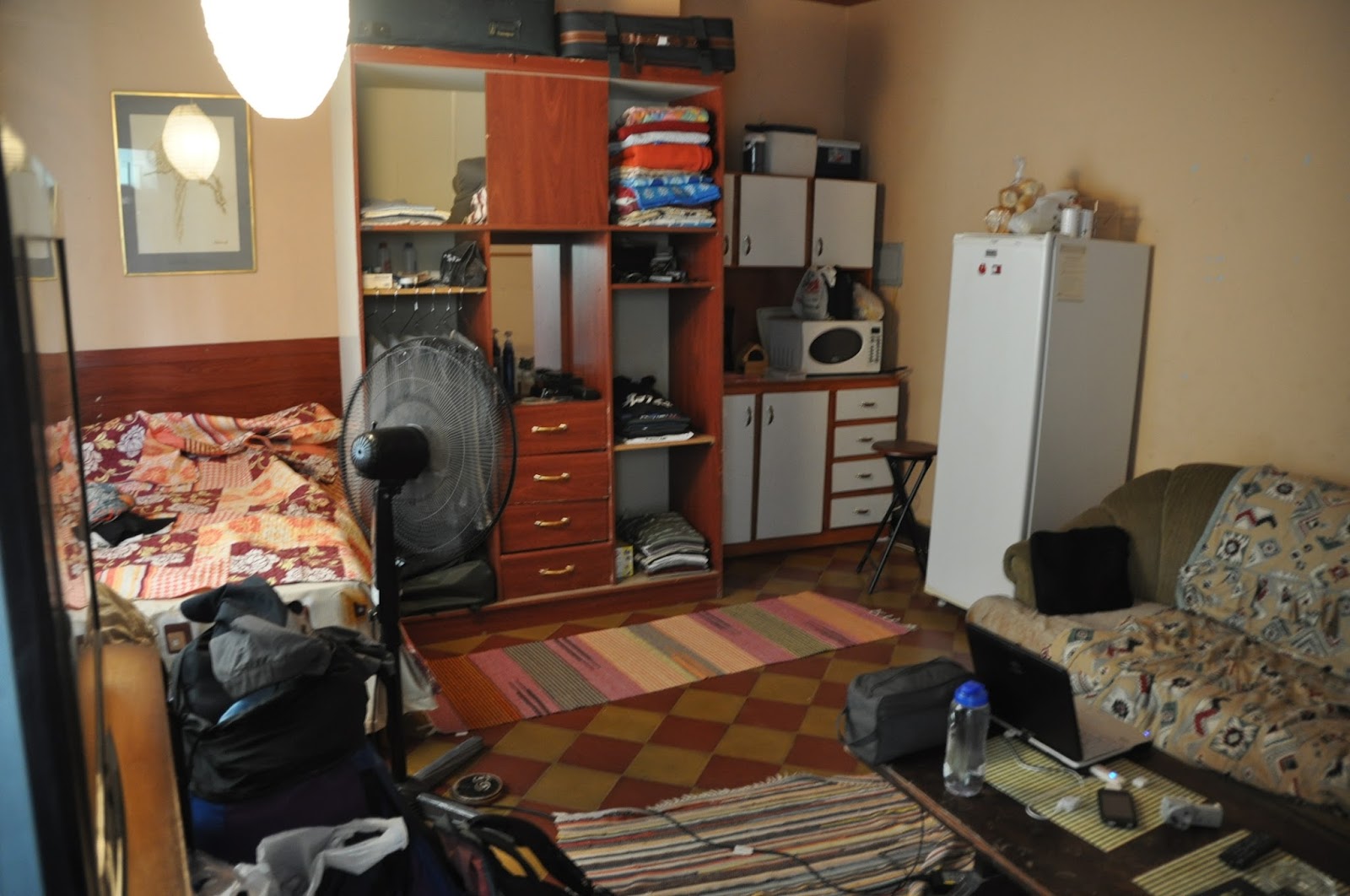
We finally learned how to make sopa Paraguay (a cake made of maze and cheese) from another host. Silvio is a gentle and caring man who wants to make sure if we feel comfortable in his place. He even gave
us his room and he went to another room of the house. He lived with his sister and her son (i.e. his cousin) Martis. We were quite impressed by the 12 yr old Martis who was a good boy. He greeted with us when meeting and we
saw him have good conversation with adults. He liked naruto comic and drew pictures about his favorite comic characters and showed them to us. We compared those Hong Kong kids who play electronic games or parents’ iphone
day and night and lost social and conversational skills. Silvio’s sister was also a talented woman who took care of the son, worked and did housework.
On the weekend after we arrived Silvio took his mother to a village in another province, thus brought us along. We had a good sight of the Paraguay country side. We were surprised to know that the mother has
not seen her sister in the village for 15 years ! Because of poverty and mobility of family they haven’t met for such a long time. Silvlo was concerned that we may feel uncomfortable about the poor situation in village.
However, we felt more honor to witness this important moment and we like to meet people no matter what they are from. After three hours of car trip we finally went to the village. His mother were greeted with enthusiasm and
happiness, she was very moved about going back to another home and meeting her family. At first we were worried that we had started a bit late (noon, we saw his mother waiting eagerly in the morning) and reached there at 3pm,
thus she did not have time to talk with them if we left the same day. In fact she would stay until next weekend when Silvio would go back to pick her up. We saw the family talking together; I wish that I could understand. Actually they were talking in Guarani, a language from aboriginal whom the Spanish missionaries came to "civilize", instead of Spanish. We had a hard time in learning Spanish already, and now learning a few extra on another language.
Silvio
taught us some Guarani to say “Ro-ei-hu” (I love you), “Ba-da-ko" (how are you), “Ser-ra-ra-hah-le" (my name is ....) The country did a good job of maintaining this aboriginal language, from a culture conquered by colonist, while other countries like Brazil and Argentina
which let the colonial Spanish become their only language and the aboriginals lost their identity because of the loss of their language. In Paraguay, Guarani and Spanish are two official languages. People learn Guarani in school; if their mother tongue is Spanish; or learn Spanish for vice versa. There are still many local folk songs sang from Guarani. We heard some from the singer we met in Asuncion.
We stayed at Silvio’s place for three more days before we bought a bus ticket to go to Encarnacion (later I was a bit regretful to stay such short as we could have gone to other suburban area). We had a good time in his place where we learnt some Paraguay cooking from his sister. His dog was also
very friendly. We also watched some films at his home as he had a collection of local and foreign films, including one Argentine independent film Chinese tale” about an only-spanish speaking metalware shop owner who Was
a loner, taking care of an only-Chinese speaking man, who is an ophan coming to Buenos Aires finding his uncle but got robbed. It was a pity that we left in his work time and we couldn’t say goodbye face-to-face with
him. haler we thought that we should stay in Asuncion longer for her beauty and having this comfortable place to stay. Thank you, Silvio I wish to see you later.
The bus system was convenient, though the vehicles look like the big nose Mercedes in Hong Kong in the 50s. Better than those buses in Brazil and Buenos Aires, respectively there was no gate to make a blocking
nuisance and no machine demanding coins, the bus here only had a driver receiving fares. A trip to the downtown only costs G2300 (around HKD4). We memorize any significant building passing by so that we could know when to take
off when back. We took off near a school in the downtown area and were impressed by the layout of the city. It was more like a town center in which citizens’ life was close to administration. Unlike Hong Kong in which the commercial and administrative districts were centralized and isolated away from residence, living here would have the courts, offices, museums and galleries a few blocks away.
The first place we visited was the Panteon de los Heros (at the middle of a central park, easy to find) which paid tribute to soldiers who died in many wars (some of which were unnecessary). There were several
metal plates given by visiting heads of government, including the presidents of Taiwan. It was quite ironic to see that the past and the current presidents, Chen and Ma respectively, were there at the same time, while one
was in jail and another was elected for one more term. In the past I have some doubt about Paraguay’s diplomatic relationship with Taiwan, for the sake of advantage given by the later. However, viewing the dictatorship of
the communist China, now I was more respectful of this country playing the game between the two countries: On one hand not to be dependent on the advantage of doing business with mainland China, which keeps on bribing her
to alienate Taiwan, on the other hand keeps relationship with Taiwan, which treasures any few diplomatic ties.
Then we walked towards the river and passed the shopping street for
tourists. Things sold in here were also tagged in US dollar, a little
expesnve due to the proximity with tourists. We found a shop named
“Hong Kong” selling mixed variety of goods but we had no interest
getting in there.
Walking on we found a pink building near the river. It
was called the “Cabildo” which was the previous congress building and
now a national museum. It was free of charge to visit and there was a
member
of staff who was so kind to take us around. He spoke some English and
introduced the exhibits, including the old congress hall for meetings.
On the first floor we saw the presentation about the river coast
project. It looked
beautiful but no one knows when it would finish. Another room showed the
artifact of the first president Eusebio Ayala who was respected in the
country for his defense against the Argentine’s attack. In another
exhibit room
we saw the exhibit about the life of Guarani aboriginal: a boat made of a
complete trunk of a tree with the special name I forgot. More
impressive was their costumes functional to the life in tropical forest.
For example,
they wore feather of “cucu” (name of a bird) on their ankles so that
snakes on the ground would be scared away. There were much more to be
seen, and listened, on the second floor. People who played guitar would
know Mangoré,
a famous guitarist who also wrote a lot of songs for classical guitar.
The exhibits also included his written scores. What a treasure ! Another
part of exhibit was Paraguai film. A famous film called Paraguai
Hemlock won a
prize in Canne and the prize was displayed here, but on the bottom shelf
of a glass cabinet. Paraguay was also famous for her harp players (such
as Espínola). One was ..., that made us eager to listen to a real harp
performance. We had such
a good time in the Calbido.
The other day we visited the town again and we went into a university “Universidad Catolica” located in an convent school next to the largest church (Iglesia Catedraw). We got all the curious look from
the students wondering why we are here. Got some water and rested for a while, we then left and went to the Casa de Independencia, a small free museum showing the life in this city in the past. Then we walked to the Palacio
Lopez, a beautiful white palace building by past dictator and the guardian was still very high. A guidebook said advance booking would allow visiting in there, we did not find that on internet so we skipped that. We crossed
the street to Manzana de la Rivera, which was an educational art-promoting comericial complex renovated from a few block of old residential building. However, it seemed not a successful project, because there was only a small
bar running, a small free museum and a small public library. Other offices supposedly for art administration or non-governmental organization were either closed or vacant. I thought of the west-kowloon “art” complex which
could turn to just hardware of building with not much activities really on art development of the city.
Not aware of other sights in the suburb and outside Asuncion, we left a bit early, also missing the meeting with a couchsurfer Gerhard who was kind enough to prepare tea at his home waiting for us. However we were
stuck by the rain-storm and could not find the bus to 10 km away Aregas. It was a pity we left to this comfortable capital. We shall come again also hope to meet Gerhard again.
Eduardo’s house is in a middle class community; a few blocks away is a luxurious community of double price. We stay in his son’s room for 3 days. It was a comfortable place. Better is that the kitchen is
big where we made a good chinese meal on a Friday party. He invited friends and also a professional singer and guitarist. He sang local Paraguay and Guarani songs and gave us a great night. As for our cooking, it was an adventure
for the whole process. Eduardo took us to a Chinese food store where we bought bean curd, sha cha (sand and tea) sauce, frozen dumplings, rice vermicelli, black beans, sesame sauce, frozen shrimp (Maria’s idea to make shrimp
in sweet and sour sauce) and very yummy freshly made spicy bamboo soot. The shop was opened by Taiwanese and we had some chat with the shopkeeper. At 7pm we were still buying ribs, chicken wings, beef strips, chicken heart,
liver and kidney and vegetable in the supermarket. We started cooking at 8pm. As people were coming we made quick appetizers: fried dumplings, cold noodle in sesame sauce, bean curd in sesame sauce and bamboo soots. The guests
seem to like the dumplings more than the other three. Then we made Shanghainese style sweet and sour ribs, chicken wing in Sha-cha sauce, shrimp in sweet and sour sauce and fried rice.
The pork was finished in 5 minutes, but there was leftover for cold noodles and bean curd. We can only blame for the bean curd which was for fried but not for cold eating. Anyway, all were satisfied and we
still haven’t made the black bean beef fried rice vermicelli. We drank a lot of beer and wine and party till 4am.
Later we also learnt to make empanadas from Eduardo’s mother Margarita. Speaking good English, she was a very talented woman that we both liked her a lot. If only we could stay longer that we could learn a
lot of Paraguay cuisine.